


A SOUTH AFRICAN FEDERATION AS A BLUEPRINT FOR AFRICAN UNITY
BEGINNING WITH LESOTHO AND SOUTH AFRICA
-
Background and Context
The legacy of arbitrary colonial borders has long undermined Africa’s unity, obstructing trade, cultural cohesion, and political integration. Lesotho presents a unique case in this context. As a landlocked constitutional monarchy entirely surrounded by the Republic of South Africa, Lesotho shares deep ethnic, cultural, and historical ties with communities across South Africa’s provinces.
The founding ancestors of the Basotho people are of the same bloodlines and heritage as those in the surrounding South African regions. Lesotho poses no threat to South Africa’s sovereignty or stability, nor does South Africa endanger Lesotho’s continued existence. Rather, the proximity, shared identity, and interdependence of the two nations present a historic opportunity for constructive unity.
A strategic starting point for healing colonial fragmentation and advancing African unity lies in the political, legal, and economic integration of Lesotho and South Africa into a federal system. This proposed federation would allow both countries to retain their unique national identities and institutions—Lesotho as a constitutional monarchy and South Africa as a republic—while operating within a shared political, economic, and legal framework.
Under a South African Federation, citizens of both countries would enjoy freedom of movement, residence, and economic participation. This process must be democratic and people-led, beginning with referendums in both nations to determine public support. If endorsed, a joint constitutional drafting process would be undertaken, establishing the guiding principles, rights, and structures of the federation.
Crucially, this federation would also recognize and elevate indigenous governance systems, many of which remain vibrant in both Lesotho and South Africa. These systems could coexist with democratic institutions on an equal constitutional footing—bridging the divide between modern governance and African traditional authority.
For too long, Basotho have been regarded as South Africa’s “best-kept secret,” and Lesotho as an isolated enclave. This union would change that narrative and serve as a catalyst for broader regional integration. Countries like Eswatini, Namibia, Botswana, Zimbabwe, and Mozambique—bound by shared history, kinship, and trade—could, in time, join the federation, extending cooperation from the Cape to the Zambezi.
This vision holds the potential to transform Southern Africa into a unified zone of open borders, shared governance, robust trade, and collective prosperity.
-
Proposed Political Framework
- Federal Structure: Form a South African Federation initially comprising South Africa and Lesotho as constituent states.
- Retention of Sovereignty: Lesotho retains its status as a Constitutional Monarchy; South Africa remains a Republic. Both coexist under a single federal constitution.
- Democratic Mandate: Initiate referendums in both countries to secure popular support and democratic legitimacy for the federation.
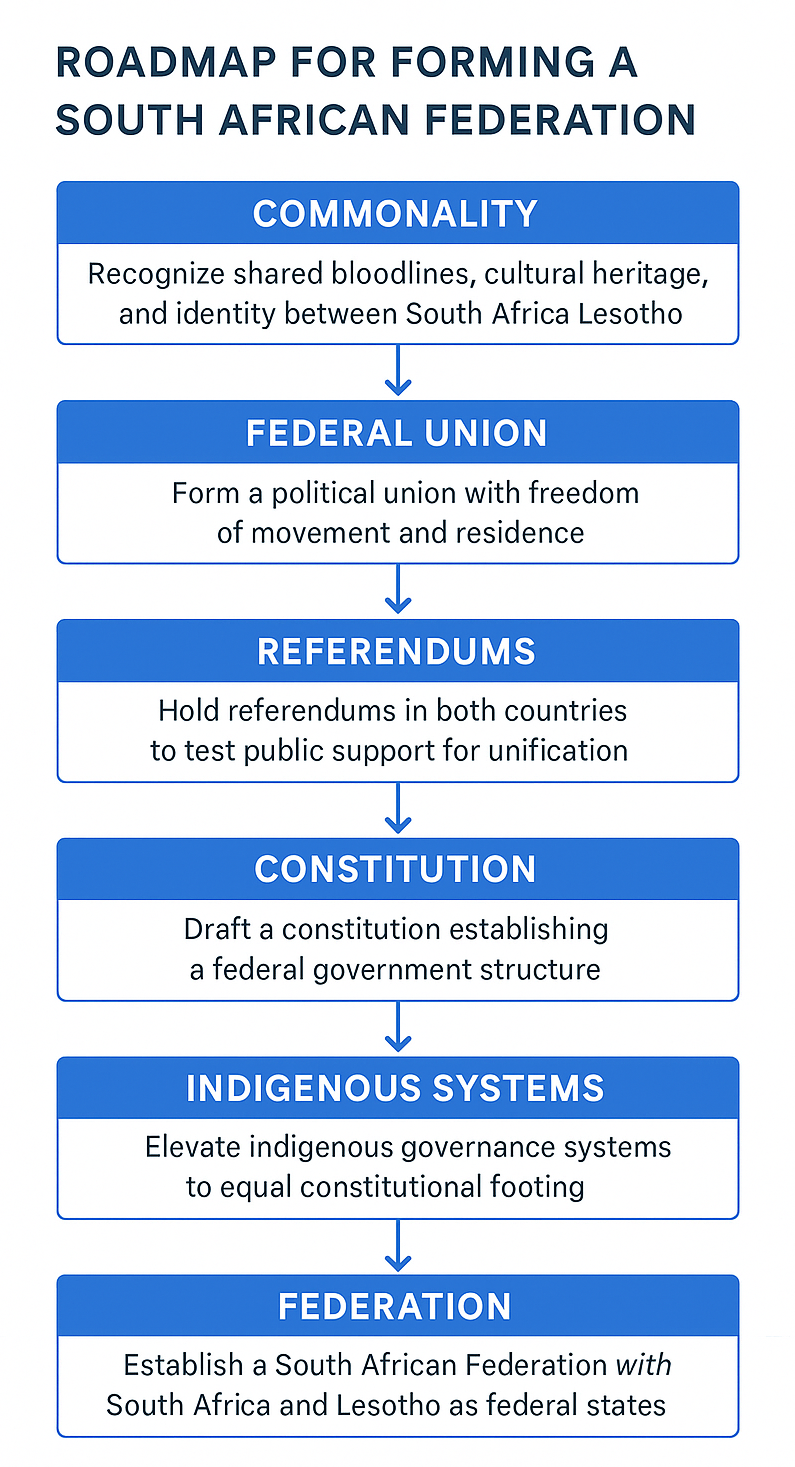
The South African Federation
-
Legal Harmonization
- Dual Citizenship: Permit citizens to hold both South African and Lesotho nationality.
- Legal Alignment: Gradually harmonize commercial, civil, and labor laws.
- Investor Protection: Enshrine protections for domestic and foreign investors in the federal constitution.
- Sovereignty Clauses: Guarantee cultural and institutional autonomy for Lesotho and traditional governance structures.
-
Economic Integration
- Special Economic Zones (SEZs): Develop SEZs in key areas to boost investment and job creation.
- Tax Harmonization: Introduce a phased plan to align tax policies and eliminate double taxation.
- Integrated Infrastructure Development: Collaborate on transport, energy, water, and digital infrastructure.
- Unified Financial Systems: Integrate mobile money, banking regulations, and payment platforms.
-
Cultural and Indigenous Governance
- Federal House of Traditional Leaders: Establish a constitutional council of traditional leaders with advisory and legislative roles.
- Multilingual Policy: Recognize multiple official languages within the federal system.
- Restitution Fund: Create a cultural and historical restitution fund to support language preservation, cultural sites, and the repatriation of heritage artifacts.
-
Social Integration
- Portable Social Benefits: Ensure healthcare, education, and welfare benefits are accessible across state borders.
- Education Compact: Enable academic mobility through scholarships, joint curricula, and student exchange programs.
- Free Movement Rights: Grant all citizens the right to live, work, and own property anywhere within the federation.
-
Institutional Development
- Federal Judiciary: Establish an independent constitutional court to adjudicate interstate and constitutional matters.
- Anti-Corruption Commission: Create a joint commission to promote financial integrity and accountability.
- Transitional Governance Body: Form an interim commission comprising legal experts, traditional leaders, youth, and women to oversee the transition.
-
Regional Expansion Model
- Observer State Status: Invite Eswatini, Namibia, Botswana, Zimbabwe, and Mozambique to participate as observer states.
- Security Cooperation: Integrate regional policing, intelligence sharing, and emergency response systems.
-
Public Participation
- People’s Assemblies: Hold public consultations in urban and rural communities to guide policy formation.
- Youth Exchange Programs: Promote national cohesion through youth mobility and leadership initiatives.
- Community Ownership Models: Encourage citizen participation in infrastructure through community-based equity schemes.
-
Stakeholder Benefits Overview
| Stakeholder | Benefit |
|---|---|
| Basotho Citizens | Economic access, cultural preservation, political voice |
| South African Citizens | Reconnection with Basotho kin, expanded regional influence |
| Investors | Legal certainty, access to unified regional markets |
| Traditional Leaders | Constitutional recognition and advisory roles |
| Youth and Students | Educational opportunities, regional mobility |
| Women and Rural Groups | Inclusion in economic and developmental programs |
Conclusion
This federation blueprint offers a practical, inclusive, and visionary path to African unity. By blending modern constitutionalism with traditional governance, and through robust citizen participation, the South African Federation can become a continental model of post-colonial healing, democratic development, and sustainable prosperity.
Next Steps
- Draft enabling legislation for referendums in Lesotho and South Africa.
- Establish bilateral working groups to explore frameworks and timelines.
- Launch coordinated public education and dialogue campaigns.
- Begin inclusive constitutional drafting with participation from traditional, civic, and political leadership.