


WORKING PAPER SERIES NO. 001
FROM TSA TO TSI | FROM CHABA TO PHIRIMA
A Linguistic, Cosmological, And Jurisprudential Reconstruction Of Basotho Solar Temporality
Author: Indigenous Kingdoms of Southern Africa (IKOSA)
Language and Cosmology Unit
Abstract
This paper establishes the Basotho temporal lexicon of Letsatsi as a coherent indigenous knowledge system integrating linguistic classification, solar observation, social regulation, and cosmological meaning. Using Southern Sotho terminology, namely Madungwadungwane, Masa, Mafube, Tsa, Chaba, Meso, Hoseng, Motšehare, Thapama, Mantsiboya, and Tsi, the study demonstrates that Basotho temporal categories encode a continuous, empirically grounded model of solar progression.
The paper advances three central claims. First, that the Basotho daytime system constitutes a high-resolution observational framework rooted in environmental and astronomical awareness. Second, that this system functions as a regulatory structure of social and economic life, and therefore qualifies as living customary law. Third, that it meets the criteria for recognition as an Integrated Indigenous Cosmological Heritage System (IICHS) within South African constitutional and heritage law.
1. Introduction
Within Basotho cosmology, time is not an abstract metric but a lived process structured through language and observation. The concept of Letsatsi extends beyond the notion of daylight. It constitutes a complete solar cycle, beginning prior to visible light and ending at the withdrawal of the sun.
This paper forms part of IKOSA’s broader project to reconstruct indigenous epistemologies as systems of knowledge, law, and governance, rather than as fragmented cultural artefacts. It proceeds on the basis that language encodes empirical, philosophical, and regulatory intelligence, and must be analysed accordingly.
2. Methodological Framework
This study adopts an integrated methodology:
Linguistic analysis, focusing on morphology, semantic range, and internal differentiation
Cosmological interpretation, grounded in lived observation of solar and environmental phenomena
Jurisprudential analysis, locating the system within constitutional and customary law
All terminology reflects Southern Sotho usage as practiced in South Africa, with Sechaba retained as the original cosmological designation of the Sun.
3. The Structure of Letsatsi as a Continuous System
The Basotho daytime sequence is expressed as:
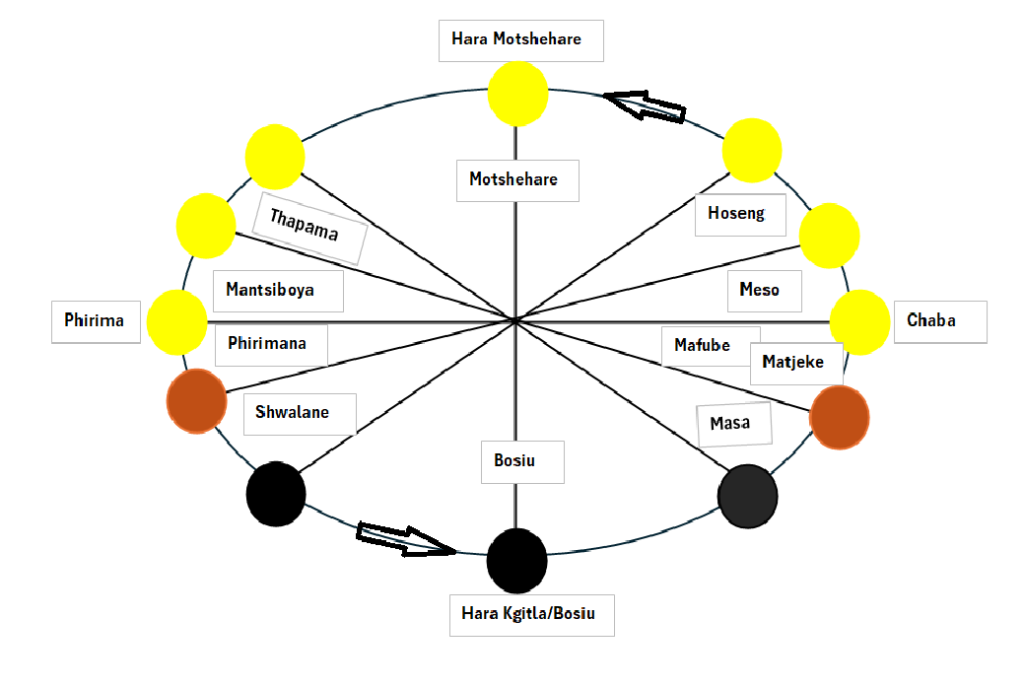
Madungwadungwane → Masa → Mafube → Matjeke → Tsa → Chaba→ Meso → Hoseng → Motshehare → Hara Motshehare → Thapama → Phirima → Tsi → Mantsiboya → Phirimana → Shwalane → Bosiu → Hara Bosiu or Kgitla
This sequence reflects a continuous, non-fragmented temporal model, in which each phase emerges from and transitions into the next.
4. Linguistic and Cosmological Analysis
4.1 Madungwadungwane and Masa (Pre-dawn)
The term exhibits reduplication, indicating diffusion, instability, and transition. It refers to the phase before visible light, where darkness persists but is no longer absolute.
Cosmologically, this phase represents:
The pre-manifest state of light
A condition in which emergence is imminent but not yet visible
This demonstrates recognition of temporal existence prior to perceptibility, a concept absent in simplified linear time systems.
4.2 Mafube (Dawn)
Mafube denotes the first spread of light across the horizon. The sun is not yet visible, but its presence is revealed through illumination.
Functionally, this phase:
- Initiates biological and social awakening
- Signals the imminent arrival of Sechaba
The distinction between Madungwadungwane, Masa and Mafube reflects fine-grained observational classification.
4.3 Chaba or Tsa (Sunrise Proper)
Tsa or Chaba marks the moment the sun breaks the horizon. It constitutes the formal beginning of visible solar authority.
This phase:
- Activates Letsatsi as a lived cycle
- Establishes the presence of Sechaba within the visible world
4.4 Mesong and Hoseng (Morning Phases)
These phases encode increasing solar elevation and corresponding social activation:
- Meso refers to early morning, characterised by low-angle light and long shadows
- Hoseng denotes fully established daylight and the commencement of sustained activity
The distinction reflects empirical observation of solar geometry and its practical implications.
4.5 Motshehare (Solar Apex)
Motshehare marks the zenith of the sun. The expression Hara Motshehare identifies the central point of equilibrium.
Observable features include:
- Minimal shadow length.
- Maximum solar intensity.
Cosmologically, this phase represents:
- The axis of balance, between ascent and descent.
- A moment of temporal symmetry.
4.6 Thapama, Phirima and Mantsiboya (Descent Phases)
Thapama signifies the onset of solar decline.
Mantsiboya marks the softening of light and extension of shadows.
These phases regulate:
- Return from labour
- Social reconvening within the settlement
They encode a structured withdrawal from outward activity, aligning human behaviour with solar descent.
4.7 Tsi (Sunset)
Tsi denotes the disappearance of the sun below the horizon.
It marks:
- The end of Letsatsi
- The transition into Bosiu
Cosmologically, it represents:
The withdrawal of Sechaba into the unseen realm.
5. Epistemic Characteristics of the System
5.1 Temporal Granularity
The system distinguishes:
- Pre-dawn from dawn
- Dawn from sunrise
- Multiple phases of ascent and descent
This reflects a high-resolution temporal framework grounded in observation.
5.2 Empirical Foundation
Each phase corresponds to:
- Solar position
- Light intensity
- Shadow behaviour
This establishes the system as:
An observational science encoded in language
5.3 Cosmocentric Organisation
The system is structured around Sechaba, not human convenience.
Human activity aligns with:
- Solar movement
- Environmental rhythms
This constitutes a cosmocentric epistemology, in contrast to anthropocentric time systems.
6. Social and Regulatory Function
The temporal system governs:
- Agricultural timing
- Labour organisation
- Movement patterns
- Social gathering and dispersal
Time therefore operates as a mechanism of social regulation, embedded within cosmology and expressed through language.
7. Jurisprudential Recognition
7.1 Cultural Rights (Sections 30 and 31)
The system constitutes an active cultural practice, enabling participation in a living tradition.
7.2 Living Customary Law (Section 211)
The Constitutional Court has affirmed that customary law evolves within communities (Bhe v Magistrate, Khayelitsha).
The Basotho temporal system:
Structures conduct
Regulates daily life
Is transmitted intergenerationally
It therefore qualifies as living law.
7.3 Traditional Authority (Section 212)
Temporal organisation forms part of indigenous governance systems and falls within the scope of traditional authority.
8. Heritage Classification
The National Heritage Resources Act 25 of 1999 recognises living heritage but does not adequately account for integrated epistemic systems.
IKOSA therefore introduces:
Integrated Indigenous Cosmological Heritage Systems (IICHS)
Defined as:
- Systems in which language, cosmology, environment, and social regulation function as a unified knowledge framework.
- The Basotho temporal system satisfies this definition.
9. Conclusion
The Basotho solar lexicon demonstrates that:
Time is observed, named, and lived as a continuous process
Linguistic categories encode astronomical and environmental precision
Cosmology functions as a regulatory and legal order
The failure to recognise such systems reflects a broader structural marginalisation of indigenous epistemologies.
IKOSA submits that constitutional and heritage frameworks must evolve to provide:
Formal recognition, protection, and integration of indigenous knowledge systems as systems of law and science
References
- Constitution of the Republic of South Africa, 1996
- National Heritage Resources Act 25 of 1999
- Bhe v Magistrate, Khayelitsha 2005 (1) SA 580 (CC)
- Hammond-Tooke, W.D. (1993). The Roots of Black South Africa
- Kunene, D.P. (1971). Heroic Poetry of the Basotho
- Vansina, J. (1985). Oral Tradition as History
- Finnegan, R. (2012). Oral Literature in Africa
- Makgopa, M. (2004). African Renaissance
IKOSA Citation Format
IKOSA Language Studies (2026)
From Tsa to Tsi, From Chaba to Phirima: A Linguistic, Cosmological, and Jurisprudential Reconstruction of Basotho Solar Temporality, Working Paper Series No. 001.