


Beyond the “Mud House”: Indigenous Building Technologies and Architectural Knowledge in Precolonial Southern Africa
IKOSA Working Paper
Author: Morena Nkokoto II (Alias Mabusa Sebobane)
Affiliation: Indigenous Kingdoms of Southern Africa NPC (IKOSA)
Abstract
For more than two centuries, colonial literature has frequently described the traditional dwellings of Southern Africa as “mud houses”, a term that oversimplifies and misrepresents indigenous construction technologies. This paper argues that precolonial Southern African societies developed sophisticated architectural systems based on locally available materials, environmental adaptation and accumulated engineering knowledge. These systems included soil block construction, dry stone masonry, timber framing, thatch roofing and portable hide shelters, each designed to meet specific climatic, ecological and social requirements.
Drawing on indigenous Sesotho terminology, oral knowledge, archaeological evidence and principles of materials science, this paper demonstrates that these structures were neither primitive nor technologically inferior. Rather, they represented sustainable engineering solutions that maximised durability, thermal efficiency and resource conservation. The paper also explores why fired brick construction was not widely adopted for domestic housing, arguing that the decision reflected practical environmental considerations rather than an absence of technological capability.
Comparisons with European wattle and daub houses, North American sod houses and other indigenous building traditions further demonstrate that the use of earth, stone, timber and vegetation formed part of a global architectural heritage. By integrating indigenous knowledge with archaeological and engineering perspectives, this paper contributes to the decolonisation of African architectural history and challenges long standing misconceptions regarding precolonial Southern African technology.
Keywords: Indigenous architecture, Southern Africa, Basotho, makote, dry stone masonry, indigenous engineering, archaeology, sustainable construction, oral history, decolonisation.
1. Introduction
Architecture represents one of humanity’s clearest expressions of scientific knowledge, engineering skill and environmental adaptation. The materials chosen by a society, the methods used to assemble them and the longevity of the resulting structures reveal much about technological capability and the relationship between people and their natural environment.
Despite this, indigenous architecture in Southern Africa has often been portrayed through a colonial lens that reduced highly sophisticated construction traditions to the simplistic label of “mud houses”. Such terminology has shaped public understanding for generations, creating the impression that indigenous communities possessed only rudimentary building skills. This characterisation fails to recognise the complexity of indigenous construction methods, the deliberate selection of materials and the engineering principles embedded within these architectural traditions.
This paper challenges that narrative by examining the principal forms of indigenous housing that existed in precolonial Southern Africa. It argues that soil block construction, dry stone architecture, timber framed thatch dwellings and portable hide shelters each represented specialised technological responses to different environmental and social conditions. Rather than reflecting technological limitations, these building systems demonstrate a deep understanding of locally available materials, structural stability, thermal performance and long term sustainability.
The discussion combines several forms of evidence. Archaeological research provides material evidence of precolonial settlements, particularly the extensive dry stone complexes found across Gauteng, the Free State, North West, Mpumalanga and Limpopo. Indigenous terminology preserved in Sesotho offers insight into the technical vocabulary associated with construction methods. Engineering principles help explain why these buildings performed effectively under Southern African climatic conditions, while oral history and lived experience provide perspectives that are often absent from conventional academic literature.
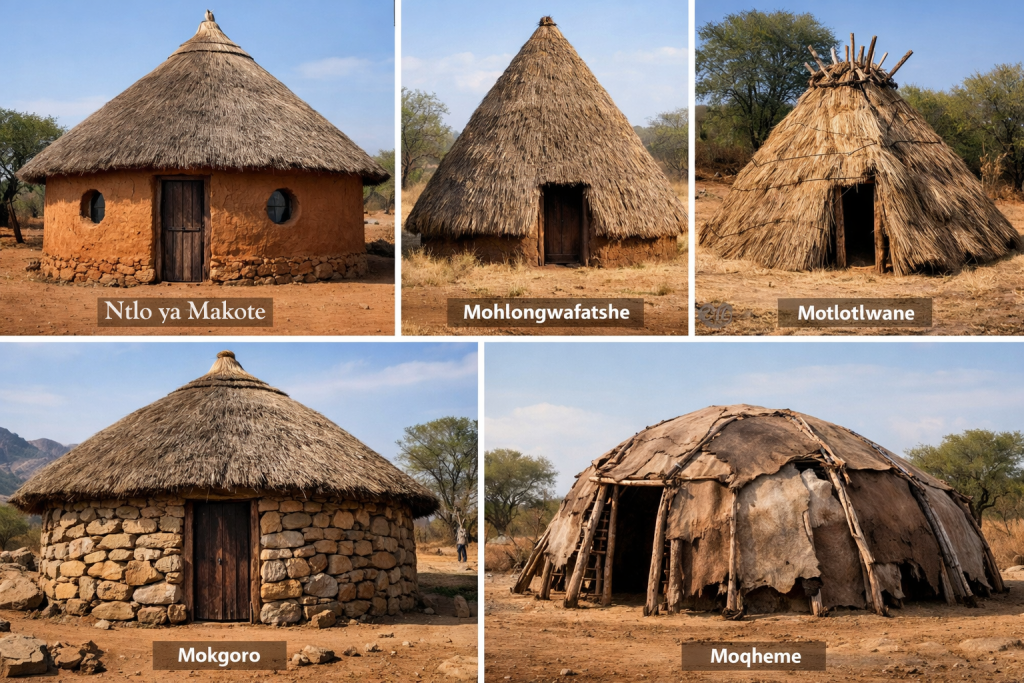
The author’s own experience of growing up in a ntlo ya makote, a house constructed from carefully cut soil slabs plastered with a mixture of soil, water and cow dung (bolokwe) , illustrates that these technologies remained practical and effective well into the twentieth century. Such lived experience forms part of a broader body of indigenous knowledge that complements archaeological and historical evidence.
The paper also considers an important historical question, namely why fired brick construction did not become the dominant form of domestic architecture among many precolonial Southern African societies. Rather than interpreting this as evidence of technological deficiency, the paper argues that indigenous builders adopted construction methods that were best suited to local environmental conditions, available resources and community needs. This reflects a principle recognised throughout engineering history, that the most appropriate technology is not necessarily the most technologically complex, but the one that best fulfils its intended purpose.
Ultimately, this study seeks to contribute to the growing body of scholarship that re-evaluates indigenous African scientific and technological achievements. By examining architecture through archaeological, linguistic, engineering and indigenous knowledge perspectives, it demonstrates that the built environment of precolonial Southern Africa deserves recognition as an important chapter in the global history of human innovation.
2. Terminology and Indigenous Knowledge
Indigenous knowledge systems are preserved not only through oral traditions, customs and practices, but also through language. In many African societies, technical vocabulary evolved to describe construction materials, architectural forms and building techniques with a level of precision that is often overlooked in colonial and postcolonial literature. The use of generalised terms such as “mud house” obscures this specialised vocabulary and, in doing so, conceals the technological knowledge embedded within indigenous languages.
 Among Sesotho speaking communities, a house constructed from compacted soil slabs is known as ntlo ya makote. The name derives from the construction material itself, makote, which refers to thick slabs of moist topsoil cut from grass covered ground and stacked to form walls. The singular form is lekote. These soil slabs were not random clumps of earth but carefully selected and cut to produce uniform building units capable of supporting substantial wall loads.
The distinction is significant because it demonstrates that indigenous builders recognised the difference between loose soil and prepared construction material. Referring to these structures as “mud houses” ignores the deliberate manufacturing process involved in producing makote, as well as the engineering knowledge required to ensure the stability and durability of the finished building.
Following the construction of the walls, builders applied a protective plaster made from water, soil and cow dung. This mixture functioned as a natural composite material. The fibrous content of the cow dung (bolokwe) increased cohesion, reduced cracking during drying and helped protect the walls against weathering and insect activity. The result was a smooth, durable surface capable of enduring seasonal climatic variations for many years with periodic maintenance.
The author was born and raised in a ntlo ya makote, providing direct experience of this construction technology. This lived experience complements archaeological and historical evidence by illustrating that the building method remained practical and effective into the modern era. Within Indigenous Studies, such testimony forms part of indigenous knowledge systems that are transmitted across generations through observation, participation and community practice.
Language also distinguishes between different categories of dwellings according to their intended purpose and construction method. A permanent thatched dwelling is known in Sesotho as ntlo ya mohlongwafatshe. Its framework consists of timber poles supporting a roof of carefully layered thatch grass, producing a structure that is both durable and thermally efficient.
A smaller temporary shelter constructed primarily from thatch is known as a motlotlwane. Because of its relatively simple design, such a shelter could be erected within a short period using locally available materials. Temporary structures of this nature served practical purposes during seasonal activities, travel or short term occupation.
Hunter gatherer communities developed another form of portable shelter known in Sesotho as a moqheme. Constructed from animal hides stretched over wooden frames, the moqheme could be assembled and dismantled quickly as communities moved across the landscape. Its portability reflected a sophisticated understanding of mobility and resource efficiency rather than an absence of permanent architectural knowledge.
The specialised vocabulary associated with these structures demonstrates that indigenous Southern African societies recognised distinct categories of architecture based on permanence, function, available materials and environmental conditions. Such terminology represents more than linguistic variation. It preserves technical knowledge concerning material selection, construction techniques and the practical application of engineering principles.
Recovering and documenting this vocabulary is therefore an essential aspect of decolonising architectural history. Indigenous languages do not merely provide names for buildings, they encode generations of accumulated knowledge regarding how structures should be designed, constructed, maintained and adapted to local environments. Any scholarly study of precolonial Southern African architecture that ignores this linguistic heritage remains incomplete.
3. Indigenous Construction Technologies
Precolonial Southern African societies developed several architectural systems, each designed to satisfy specific environmental, economic and social requirements. Rather than relying on a single method of construction, indigenous builders selected materials according to local geology, vegetation, climate, intended duration of occupation and the availability of labour. The resulting architectural diversity reflects a sophisticated understanding of engineering, environmental adaptation and sustainable resource management.
3.1 Soil Slab Construction (Ntlo ya Makote)
The construction of a ntlo ya makote began with the careful selection of suitable ground. Builders preferred moist, compact topsoil covered by healthy grass, where the root network helped bind the soil into firm blocks. Using hand tools, they cut rectangular slabs known as makote. These slabs possessed sufficient strength to be transported and stacked without collapsing.
The walls were erected by placing the makote in overlapping courses, creating a thick and stable structure. Unlike modern fired bricks, these soil blocks required no kiln firing and consumed no fuel during production. Their manufacture depended entirely upon knowledge of soil composition, moisture content and careful workmanship.
After the walls had dried and settled, they were plastered with a mixture of soil, water and cow dung. Modern materials science helps explain the effectiveness of this mixture. The fibrous material within cow dung acted as natural reinforcement, reducing shrinkage and limiting the formation of cracks. Once cured, the plaster formed a durable protective coating that resisted weathering while remaining easy to repair using locally available materials.
These houses also possessed excellent thermal properties. Their thick earthen walls absorbed heat slowly during the day and released it gradually during the night, helping to maintain relatively stable indoor temperatures throughout the year.
3.2 Thatch Architecture
Grass was among the most versatile renewable resources available to indigenous communities. Properly harvested and dried, thatch provided durable roofing material with excellent insulating properties.
Permanent thatched houses, known in Sesotho as ntlo ya mohlongwafatshe, were constructed around timber frames made from carefully selected tree trunks, poles and branches. The roof was built by layering bundles of thatch in overlapping rows that efficiently channelled rainwater away from the structure while allowing the roof to breathe naturally.
For shorter periods of occupation, communities constructed smaller shelters known as motlotlwane. These could be erected rapidly using locally available materials and required relatively little labour. Their temporary nature reflected practical adaptation to seasonal activities rather than technological simplicity.
3.3 Timber Lattice and Earth Composite Construction
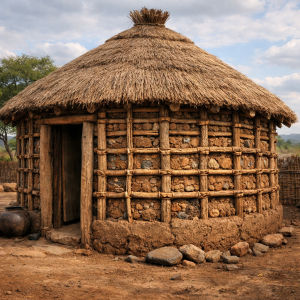 A further indigenous construction method combined timber, plant fibres and earth to produce durable wall structures. This technique illustrates another example of the diversity and sophistication of precolonial Southern African architecture.
Construction began by erecting thick tree branches or timber poles to form the primary structural framework of the house. Smaller flexible branches were then woven or tied horizontally between the supporting poles, creating a strong lattice or basket like framework that formed the walls.
The lattice was secured using ropes or bindings made from indigenous plant fibres. Once the framework had been completed, the spaces within the lattice were filled with a carefully prepared mixture of soil, water, small stones and cow dung. The stones increased the strength of the wall, while the cow dung acted as a natural binding agent that improved cohesion, reduced cracking and enhanced durability.
After drying, the walls were often plastered with additional layers of soil and cow dung to produce a smooth weather resistant surface.
From an engineering perspective, this construction method functioned as a composite structural system. The timber framework carried tensile and lateral forces while the earthen infill provided compressive strength, thermal mass and weather protection. Together, these materials produced walls that were lightweight, structurally stable and well adapted to Southern Africa’s climate.
The engineering principles underlying this construction method closely resemble timber and earth composite systems that evolved independently in many parts of the world. Their appearance in geographically distant societies provides further support for the principle of independent engineering convergence discussed later in this paper.
The existence of this architectural tradition demonstrates that indigenous Southern African builders did not rely upon a single construction technique. Instead, they developed multiple engineering solutions, each adapted to locally available materials, environmental conditions and the intended function of the structure.
3.4 Dry Stone Architecture
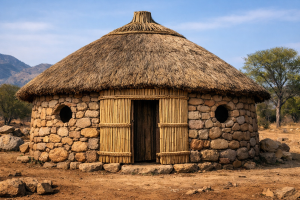
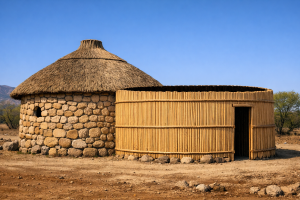 Perhaps the most enduring evidence of indigenous engineering survives in Southern Africa’s extensive dry stone settlements. These structures were built without mortar, relying instead upon careful selection and placement of naturally occurring stones.
Builders selected stones according to size, shape and load bearing characteristics. Larger stones formed the foundation, while progressively smaller stones filled gaps and stabilised the structure. Through careful interlocking, the walls distributed weight evenly while resisting movement caused by weather, gravity and ground settlement.
The remarkable preservation of many precolonial stone settlements demonstrates the effectiveness of these engineering principles. In numerous locations, walls constructed several centuries ago remain standing despite prolonged exposure to seasonal rainfall, temperature fluctuations and vegetation growth.
These settlements also reveal sophisticated planning. Residential areas, livestock enclosures, terraces, passageways and defensive features were often integrated into coherent settlement layouts, indicating organised communities possessing specialised knowledge of construction and spatial planning.
3.5 Portable Hide Shelters
Not all indigenous societies required permanent settlements. Hunter gatherer communities developed portable shelters that reflected their highly mobile way of life.
Known in Sesotho as moqheme, these shelters consisted of animal hides stretched over lightweight wooden frames. The design enabled rapid assembly and dismantling while providing effective protection against wind, rain and sunlight.
From an engineering perspective, portability represented an advantage rather than a limitation. The shelter could be transported with minimal effort and reconstructed wherever seasonal movements required. Similar design principles continue to be employed in modern camping tents and portable expedition shelters throughout the world.
3.6 Indigenous Engineering Principles
Although these construction methods differed in appearance and materials, they shared several underlying engineering principles. Each made effective use of locally available resources, minimised waste, reduced energy consumption during construction and produced buildings well suited to Southern African climatic conditions.
These technologies illustrate that indigenous builders consistently selected materials according to performance rather than prestige. Durability, thermal comfort, maintainability, structural stability and environmental sustainability formed the foundation of indigenous architectural practice long before these concepts became central to modern sustainable engineering.
4. Engineering Analysis of Indigenous Southern African Architecture
Engineering is commonly defined as the practical application of scientific knowledge to solve human problems. Although precolonial Southern African societies did not formulate engineering principles using modern scientific terminology, their architectural traditions demonstrate systematic knowledge of materials, structural behaviour, environmental adaptation and construction techniques accumulated over many generations.
Rather than viewing indigenous housing as a collection of isolated building practices, this paper argues that these construction methods constituted an integrated engineering system. Every major construction material, soil, stone, timber, grass and animal hide, was selected because its physical properties satisfied specific structural and environmental requirements.
4.1 Materials Engineering
The choice of construction material reflects an understanding of mechanical performance.
The makote used in soil slab construction were neither loose earth nor randomly excavated soil. Builders selected cohesive topsoil whose natural root structure improved the integrity of each slab during handling and construction. Once assembled into thick walls and protected by a plaster of soil, water and cow dung, the structure developed considerable resistance to weathering.
Similarly, dry stone builders demonstrated an advanced understanding of load distribution. Instead of reshaping stones into uniform blocks, they exploited the natural geometry of each boulder, allowing gravity and careful interlocking to produce exceptionally stable walls. This reduced labour while increasing structural durability.
Timber and thatch were likewise selected according to their mechanical properties. Timber provided tensile strength and flexibility, while densely layered thatch produced lightweight roofing with excellent insulating characteristics.
These examples illustrate deliberate material selection based upon observed performance rather than random availability.
4.2 Structural Engineering
Indigenous Southern African architecture reveals numerous structural principles recognised within modern engineering.
Thick earthen walls lowered the centre of gravity and increased stability.
Interlocking stone walls distributed compressive forces throughout the structure.
Cone shaped thatched roofs transferred loads efficiently towards the supporting walls while reducing wind resistance.
Timber frameworks distributed roof loads without requiring complex joints or metal fasteners.
Portable hide shelters balanced structural stability with rapid assembly and transportation.
These structural solutions demonstrate repeated refinement rather than isolated experimentation.
4.3 Thermal Engineering
One of the most remarkable achievements of indigenous architecture lies in its passive climate control.
Long before mechanical heating or air conditioning, indigenous builders designed homes that naturally regulated internal temperatures.
The thermal mass of earthen walls absorbed heat slowly during daylight hours before releasing it gradually during cooler evenings.
Thatch roofs reduced solar heat gain while trapping warm air during winter.
Stone walls similarly moderated daily temperature fluctuations through their high thermal capacity.
These characteristics produced comfortable living conditions using no external energy source.
Modern architects increasingly describe such systems as passive environmental design, a concept that indigenous builders had already mastered through practical experience.
4.4 Sustainability Engineering
Contemporary engineering increasingly emphasises sustainable construction, reduced carbon emissions and renewable materials. Indigenous Southern African architecture demonstrates that these principles were already embedded within traditional building systems.
Construction materials were obtained locally.
Energy consumption during construction remained minimal.
Building waste was negligible.
Damaged structures could be repaired rather than demolished.
Materials could often return safely to the natural environment after abandonment.
Measured against many modern sustainability standards, these indigenous construction methods possess an exceptionally low environmental footprint.
4.5 Maintenance Engineering
Durability depended not only upon construction but also upon systematic maintenance.
Families periodically replastered earthen walls using fresh mixtures of soil, water and cow dung.
Damaged sections of thatch could be replaced individually without dismantling the entire roof.
Loose stones within dry stone walls could be repositioned without rebuilding complete structures.
This maintenance philosophy extended the useful life of buildings while reducing labour and material costs.
Rather than treating maintenance as evidence of structural weakness, it should be understood as part of an engineering system designed for continuous renewal.
4.6 Innovation Through Generational Knowledge
Engineering innovation rarely occurs through a single invention. Instead, successful technologies are refined over successive generations as communities observe failures, improve designs and transmit knowledge to future builders.
The consistency with which indigenous construction methods appear across large areas of Southern Africa suggests precisely this process of cumulative innovation. Communities preserved successful techniques while modifying them to suit local geology, vegetation, rainfall patterns and settlement requirements.
Such refinement represents one of the defining characteristics of engineering. The durability of surviving stone settlements, together with the continued use of soil slab and thatch construction into recent times, demonstrates that these technologies achieved a high level of functional optimisation.
Consequently, indigenous Southern African architecture should not be interpreted merely as vernacular building practice. It represents an engineering tradition grounded in empirical observation, environmental adaptation, material science and the cumulative transmission of technical knowledge across generations.
Recognising these achievements requires more than replacing the expression “mud house” with more accurate terminology. It requires acknowledging that precolonial Southern African societies developed sophisticated engineering systems capable of producing durable, sustainable and climate responsive buildings long before the emergence of modern engineering disciplines.
5. Independent Engineering Convergence in Indigenous Architecture
One of the strongest arguments against the colonial characterisation of indigenous Southern African architecture as technologically primitive is the remarkable similarity between its engineering solutions and those developed independently in many other parts of the world. These similarities should not necessarily be interpreted as evidence of cultural borrowing. Rather, they illustrate the principle of independent engineering convergence, whereby geographically separated societies arrive at comparable technological solutions because they face similar environmental conditions, material constraints and functional requirements.
Engineering is ultimately governed by the laws of nature. Gravity, structural stability, thermal performance, water management and the mechanical properties of materials operate independently of culture or geography. Consequently, communities confronted with similar challenges frequently develop similar solutions even in the absence of direct contact.
5.1 Soil Based Construction
The ntlo ya makote illustrates this principle particularly well.
Southern African builders produced structural walls from carefully cut soil slabs reinforced with protective plaster. Although the techniques differed in detail, comparable methods appeared independently in other parts of the world.
Across the Great Plains of North America, settlers constructed sod houses from thick blocks of grass covered earth. Like makote, these blocks relied upon intertwined root systems to maintain structural integrity.
In parts of Europe, builders employed wattle and daub construction, using woven timber frameworks coated with clay, straw and animal dung to produce insulated walls.
In the Middle East and North Africa, earthen architecture developed through adobe and rammed earth construction, both of which exploited the thermal properties of compacted soil.
Each of these technologies emerged under different historical circumstances, yet all demonstrate the same engineering principle, locally available earth can become a durable construction material when its physical properties are properly understood.
5.2 Stone Construction
Dry stone architecture likewise represents an example of engineering convergence.
Across Southern Africa, indigenous builders erected substantial settlements using naturally shaped stones carefully interlocked without mortar.
Comparable dry stone traditions developed independently in regions such as the Scottish Highlands, the Mediterranean Basin, the Andes and parts of East Asia.
Although these societies differed greatly in language, political organisation and culture, each recognised that carefully interlocking naturally shaped stones could produce remarkably durable walls requiring little maintenance.
The similarity reflects the universal behaviour of compressive stone structures rather than direct technological transmission.
5.3 Thatch Roofing
Thatch roofing also emerged independently across numerous continents.
Grass, reeds and palm leaves have long been used throughout Europe, Asia, Oceania and Africa because they provide lightweight roofing with excellent insulating properties.
The physical principles governing rainwater runoff, heat transfer and roof ventilation remain constant regardless of geography.
Consequently, indigenous Southern African thatch architecture belongs to a worldwide engineering tradition that maximised the performance of renewable vegetation.
5.4 Portable Shelters
Hunter gatherer communities across the world developed portable shelters based upon flexible wooden frames covered with animal hides or woven materials.
The Sesotho moqheme shares functional similarities with the hide tents of Indigenous peoples of North America, the yurts of Central Asia and other mobile shelter systems developed by pastoral and hunting societies.
Although these structures differ in detail, each balances portability, structural stability, weather protection and efficient use of available materials.
Their similarities arise because mobility imposes universal engineering requirements upon shelter design.
5.5 Engineering Optimisation
Independent engineering convergence also explains why many indigenous technologies changed only gradually over time.
Once builders discovered designs that effectively balanced strength, durability, labour requirements and resource availability, radical redesign offered relatively little advantage.
The persistence of dry stone construction, thatch roofing and soil based housing over many centuries therefore reflects technological optimisation rather than technological stagnation.
Modern engineering frequently reaches similar conclusions. Many bridges, roofs and structural systems retain design principles developed generations ago because they continue to satisfy engineering requirements efficiently.
The longevity of indigenous architectural traditions should therefore be interpreted as evidence of successful optimisation rather than resistance to innovation.
5.6 Rethinking Technological Development
Colonial narratives often assumed that technological development followed a single universal pathway culminating in fired brick, concrete, steel and industrial construction.
Such interpretations measure all societies against one particular technological trajectory while overlooking the possibility that different environments encourage different engineering solutions.
The evidence presented in this paper suggests a more nuanced understanding.
Precolonial Southern African societies did not fail to develop engineering. They developed engineering systems that responded effectively to their own environments, climates and available resources.
Recognising independent engineering convergence therefore requires abandoning hierarchical models of technological history. Instead of classifying indigenous architecture as primitive because it differed from European masonry traditions, scholars should evaluate it according to its performance, sustainability, durability and suitability for its intended environment.
Viewed through this perspective, indigenous Southern African architecture emerges not as an incomplete stage of technological development, but as a mature engineering tradition that evolved independently while arriving at many of the same functional solutions observed elsewhere in the world.
Its significance lies not only in what it reveals about Southern Africa, but also in what it demonstrates about humanity’s shared capacity for scientific observation, engineering innovation and environmental adaptation.
6. Archaeological Evidence for Indigenous Engineering
The strongest evidence for the sophistication of precolonial Southern African architecture is preserved not in written records, but in the archaeological landscape itself. Across large parts of present day South Africa, thousands of stone walled settlements bear witness to centuries of indigenous engineering, settlement planning and environmental adaptation. These archaeological remains demonstrate that stone construction formed an established architectural tradition long before European colonisation.
The concentration of stone settlements across the northern Free State, Gauteng, North West, Mpumalanga and Limpopo represents one of the most extensive archaeological landscapes in Southern Africa. Together, these settlements provide material evidence that indigenous builders possessed highly developed knowledge of structural engineering, spatial planning and long term community organisation.
6.1 The Northern Free State Stone Settlements
The northern Free State contains numerous precolonial stone settlements that have received relatively little public attention despite their archaeological significance.
Examples occur in and around Deneysville, Frankfort, Heilbron, Petrus Steyn, Steynsrus, Koppies and Vredefort. Many of these settlements occupy elevated terrain or strategically selected landscapes overlooking rivers, valleys and grazing areas.
Among the most culturally significant sites is Ntswanatsatsi, remembered in Basotho oral traditions as an important ancestral place. While archaeological investigation continues to develop our understanding of the site, its enduring presence within both the archaeological and oral historical record illustrates the close relationship between landscape, memory and indigenous identity.
The distribution of these settlements indicates that stone architecture was neither isolated nor exceptional. Rather, it formed part of an extensive regional tradition of permanent settlement extending across much of the interior plateau.
6.2 Gauteng and the Cradle of Indigenous Engineering
Present day Gauteng contains one of the highest concentrations of precolonial stone walled settlements in Southern Africa.
Among the best documented are the Kweneng ruins within the Suikerbosrand region, the stone settlements associated with the Klip River valley, extensive archaeological remains throughout the Magaliesberg Valley, the stone walling around Randfontein and the archaeological landscape preserved at Melville Koppies.
Far from representing isolated villages, these settlements formed interconnected occupation landscapes linked by pathways, agricultural terraces, livestock enclosures and water management systems.
Recent archaeological research has demonstrated that some settlements expanded into remarkably large urban landscapes capable of supporting substantial populations long before European settlement in the region.
6.3 Settlement Planning
The archaeological evidence demonstrates that indigenous settlements were carefully planned rather than randomly constructed.
Residential compounds were frequently organised around livestock enclosures.
Stone walls defined circulation routes between households.
Agricultural land lay beyond residential areas while defensive considerations influenced settlement location.
Many settlements display repeated architectural patterns over wide geographical areas, suggesting that construction knowledge was transmitted across generations through established building traditions.
This consistency represents one of the strongest indicators of organised engineering practice.
6.4 Structural Durability
Perhaps the most compelling engineering evidence lies in the remarkable durability of these structures.
Constructed entirely without cement or mortar, many stone walls have survived for several centuries despite continuous exposure to rainfall, seasonal temperature variation, vegetation growth and occasional human disturbance.
Their survival reflects an advanced understanding of compressive forces, foundation stability, drainage and stone selection.
Modern structural engineers recognise that dry stone construction requires careful balancing of weight, friction and geometry.
The archaeological evidence demonstrates that indigenous builders mastered these principles through empirical observation and accumulated practical knowledge.
6.5 Archaeology and Oral Tradition
Archaeological evidence and indigenous oral traditions should not be viewed as competing sources of historical knowledge. Rather, each contributes different forms of evidence.
Archaeology documents physical remains.
Oral traditions preserve cultural memory, place names, migration histories and ancestral relationships with particular landscapes.
When interpreted together, these knowledge systems often provide a richer understanding of precolonial societies than either could achieve independently.
For example, sites such as Ntswanatsatsi possess significance not only because of their archaeological remains but also because they continue to occupy an important place within Basotho historical consciousness.
Such relationships between landscape and memory form an important component of Indigenous Studies and deserve greater recognition within archaeological scholarship.
6.6 Reassessing Southern African Civilisation
The cumulative archaeological evidence fundamentally challenges the long standing stereotype that precolonial Southern African societies consisted only of scattered temporary settlements lacking permanent architecture.
Instead, the archaeological landscape reveals organised communities capable of constructing durable settlements, managing livestock, planning residential space and adapting architecture to diverse environmental conditions.
These achievements required skilled builders, specialised knowledge, intergenerational training and sophisticated understanding of locally available materials.
Rather than representing isolated engineering accomplishments, the stone settlements of the northern Free State, Gauteng and neighbouring provinces formed part of a continuous architectural tradition extending across much of Southern Africa.
Their preservation today provides enduring material evidence that indigenous engineering was both sophisticated and sustainable. Far from being relics of a forgotten past, these settlements remain among the continent’s most important monuments to African scientific knowledge, architectural innovation and engineering achievement.
7. Rethinking the Absence of Fired Brick Architecture
One of the questions frequently raised in discussions of precolonial Southern African architecture is why fired brick construction did not become the dominant method of domestic building despite the existence of sophisticated engineering traditions.
The question itself deserves careful examination because it often reflects an assumption inherited from nineteenth century European scholarship, namely that technological progress follows a single universal pathway culminating in fired brick, cement and industrial construction. Such an assumption treats European architectural history as the standard against which all other societies are measured.
This paper proposes a different interpretation. Rather than asking why indigenous Southern African societies “failed” to adopt fired brick construction, it is more appropriate to ask whether fired brick architecture would have offered significant practical advantages over the building technologies already in use.
7.1 Appropriate Technology
Engineering seeks the most effective solution to a particular problem, not necessarily the most technologically complex one.
Throughout precolonial Southern Africa, indigenous builders had already developed architectural systems that successfully addressed the principal requirements of domestic housing.
Their buildings provided structural stability.
They protected occupants from seasonal rainfall.
They moderated indoor temperatures throughout the year.
They could be repaired using locally available materials.
They required relatively little external energy during construction.
Measured against these objectives, indigenous architecture functioned remarkably well.
Introducing fired brick construction would have required additional labour, greater fuel consumption and specialised production facilities without necessarily producing proportionate improvements in performance.
7.2 Resource Economics
Brick manufacture depends upon several important resources.
Suitable clay deposits must be identified.
Large quantities of fuel are required to fire bricks at high temperatures.
Kilns must either be constructed or maintained.
Considerable labour is necessary to mould, dry, transport and fire the bricks.
By contrast, soil slabs, natural stone, timber and thatch could usually be obtained directly from the surrounding environment with comparatively little processing.
From the perspective of resource economics, indigenous construction methods represented highly efficient use of locally available materials.
7.3 Thermal Performance
Modern architecture increasingly recognises the importance of passive thermal design.
Thick earthen walls possess high thermal mass, allowing them to absorb heat during the day and release it gradually after sunset.
Thatch roofing provides excellent insulation while allowing natural ventilation.
Stone walls similarly moderate internal temperatures because of their thermal capacity.
These properties remain highly desirable even within contemporary sustainable architecture.
Fired brick construction does not automatically outperform these indigenous materials under every climatic condition.
In many parts of Southern Africa, traditional construction methods provided thermal comfort that was already well suited to local environmental conditions.
7.4 Sustainability
Perhaps the most striking feature of indigenous Southern African architecture is its environmental sustainability.
Construction materials were renewable or naturally abundant.
Little waste was generated.
Minimal external energy was required during construction.
Buildings could be repaired rather than demolished.
When eventually abandoned, many materials returned harmlessly to the surrounding environment.
By comparison, fired brick manufacture consumes substantial amounts of energy and fuel while producing significantly greater environmental impacts.
Although precolonial societies did not describe their practices using modern environmental terminology, their construction systems embodied many principles now associated with sustainable engineering.
7.5 Maintenance and Adaptability
Indigenous buildings were designed as living structures rather than permanent monuments.
Earthen walls could be replastered periodically.
Individual sections of thatch roofing could be replaced without dismantling the entire building.
Dry stone walls could be repaired by repositioning displaced stones.
This flexibility enabled buildings to remain functional across generations while adapting to changing household needs.
Such adaptability represents an important engineering advantage that is often overlooked when comparing indigenous architecture with industrial building systems.
7.6 Technological Choice and Technological Capability
History repeatedly demonstrates that societies do not adopt every technology available to them.
Technological capability does not automatically lead to technological adoption.
Communities evaluate innovations according to environmental conditions, available resources, labour requirements, cultural preferences and practical usefulness.
The archaeological evidence suggests that indigenous Southern African builders possessed well developed engineering knowledge. Their continued reliance upon soil, stone, timber and thatch should therefore not be interpreted as evidence of technological incapacity.
Rather, it reflects confidence in architectural systems that had already demonstrated their effectiveness over many generations.
This distinction is fundamental to understanding technological history. The absence of widespread fired brick domestic architecture should not be interpreted as a missing stage of civilisation. Instead, it illustrates that different societies may legitimately pursue different engineering pathways while achieving comparable functional outcomes.
Viewed from this perspective, indigenous Southern African architecture represents not an incomplete technological journey toward European building methods, but an independent architectural tradition that reached its own state of engineering maturity through environmental adaptation, accumulated experience and continuous innovation.
8. Lived Experience as Indigenous Evidence and a Call for Community Participation
The study of indigenous architecture cannot rely exclusively on archaeology, historical documents and scientific analysis. Much of the technical knowledge associated with precolonial construction survives within the memories of elders and those who grew up living in traditional homes. This body of knowledge constitutes an important form of indigenous evidence that deserves systematic documentation before it is permanently lost.
The author was born and raised in a ntlo ya makote, a traditional dwelling constructed from carefully cut soil slabs and plastered with a mixture of soil, water and cow dung. This experience provided first hand knowledge of the performance of indigenous building materials under everyday living conditions, including their durability, thermal comfort, maintenance requirements and seasonal behaviour.
While personal experience cannot replace archaeological investigation or scientific analysis, it offers an important source of contextual evidence. Indigenous knowledge is transmitted through observation, participation and practice. Individuals who have lived in, maintained or constructed traditional homes possess technical knowledge that is seldom recorded in formal academic literature.
Many elders throughout Southern Africa retain detailed knowledge of selecting suitable soils, harvesting thatch, preparing plaster mixtures, constructing timber frameworks and maintaining stone and earthen structures. Their knowledge represents a living archive of engineering practice that is rapidly disappearing as traditional construction methods become less common.
For this reason, IKOSA invites historians, archaeologists, architects, engineers, linguists, heritage practitioners, traditional leaders and members of the public to contribute their knowledge to this growing body of research.
Community members are encouraged to share:
- Indigenous names for different types of houses and construction materials.
- Traditional construction techniques and building sequences.
- Local variations in architectural design.
- Oral histories relating to settlement patterns and ancestral villages.
- Photographs, sketches and maps of surviving traditional structures.
- Family experiences of living in indigenous homes.
- Knowledge relating to maintenance, repair and seasonal adaptation of traditional buildings.
- Local terminology that may differ across dialects and regions.
Such contributions will enable future editions of this research to reflect the diversity of indigenous architectural traditions across Southern Africa.
The author recognises that no single paper can fully document the architectural knowledge developed over many centuries by the region’s indigenous communities. This publication should therefore be regarded as the beginning of an ongoing collaborative research programme rather than its final conclusion.
IKOSA further proposes the establishment of an Indigenous Architecture and Engineering Archive, a permanent repository dedicated to preserving oral histories, indigenous terminology, archaeological observations, architectural drawings, photographs and technical knowledge relating to precolonial Southern African construction technologies.
The preservation of indigenous engineering knowledge is not merely an academic undertaking. It is an act of cultural restoration. Every elder interviewed, every traditional building documented and every indigenous term preserved contributes to a more complete understanding of Southern Africa’s scientific, technological and architectural heritage.
The future of indigenous knowledge depends not only on scholars and universities, but also on the communities that continue to carry this knowledge across generations. This paper therefore extends an open invitation to all who possess lived experience of indigenous architecture to become active participants in preserving one of Africa’s oldest and most enduring engineering traditions.
9. Conclusion
This paper has argued that the long standing description of indigenous Southern African dwellings as “mud houses” fails to recognise the sophistication of precolonial architectural knowledge and engineering practice. Archaeological evidence, indigenous terminology, engineering analysis and lived experience collectively demonstrate that these structures were the product of systematic observation, environmental adaptation and generations of accumulated technical knowledge.
| Type | Primary Material | Structural System | Permanence |
|---|---|---|---|
| Ntlo ya makote | Soil slabs | Load bearing earthen walls | Permanent |
| Timber lattice and earth composite | Timber, earth, cow dung, stones | Timber frame with earthen infill | Permanent |
| Ntlo ya mohlongwafatshe | Timber and thatch | Timber frame with thatched roof | Permanent |
| Motlotlwane | Thatch and timber | Lightweight temporary frame | Temporary |
| Moqheme | Animal hides and timber | Portable framed shelter | Mobile |
| Dry stone settlements | Stone | Dry stone masonry | Permanent |
The construction of ntlo ya makote, dry stone settlements, thatched dwellings and portable hide shelters illustrates that indigenous builders understood structural stability, thermal regulation, material performance and sustainable resource management. These technologies were neither accidental discoveries nor incomplete attempts at industrial construction. They were mature engineering systems designed to satisfy the environmental, economic and social needs of the communities that developed them.
The archaeological landscapes of the northern Free State, Gauteng, North West, Mpumalanga and Limpopo remain among the most significant material records of indigenous engineering in Southern Africa. They deserve greater scholarly attention, stronger legal protection and broader public recognition as part of Africa’s scientific and technological heritage.
The paper has also proposed the concept of independent engineering convergence as a framework for understanding why similar architectural solutions emerged in geographically distant societies. Rather than measuring indigenous technologies against European industrial history, future scholarship should evaluate them according to their effectiveness, sustainability and suitability within their own environmental and cultural contexts.
Finally, this study recognises that much indigenous architectural knowledge remains preserved within living communities. The memories of elders, traditional builders and those who grew up in indigenous homes constitute an invaluable archive of technical knowledge. Recording this knowledge is an urgent scholarly responsibility.
This working paper should therefore be regarded not as the final word on indigenous Southern African architecture, but as the beginning of a broader research programme dedicated to recovering, documenting and preserving one of Africa’s oldest engineering traditions.
The IKOSA Declaration on Indigenous Architecture and Engineering
The Indigenous Kingdoms of Southern Africa NPC (IKOSA) affirms that the architectural traditions of the indigenous peoples of Southern Africa constitute an integral part of the region’s scientific, technological and cultural heritage.
IKOSA therefore declares that:
- Indigenous architectural knowledge should be recognised as a legitimate field of scientific, engineering and historical inquiry.
- Terms such as “mud house” should be replaced, where appropriate, by accurate indigenous terminology that reflects the true nature of traditional construction technologies.
- Precolonial stone settlements and indigenous architectural landscapes should receive enhanced protection through national and provincial heritage policies.
- Indigenous languages should be recognised as repositories of technical and engineering knowledge, with traditional architectural terminology documented and preserved.
- Universities, museums, schools and heritage institutions should incorporate indigenous engineering achievements into teaching, research and public exhibitions.
- Archaeologists, engineers, architects, historians, linguists and indigenous knowledge holders should collaborate in documenting Southern Africa’s architectural heritage using interdisciplinary research methods.
- Oral testimony and lived experience should be recognised as important forms of evidence that complement archaeology, engineering analysis and documentary research.
- IKOSA shall work towards establishing an Indigenous Architecture and Engineering Archive to preserve oral histories, photographs, architectural drawings, maps, terminology and technical knowledge relating to indigenous construction.
- IKOSA invites researchers, traditional leaders, community elders, builders, heritage practitioners and members of the public to contribute evidence, oral histories and technical knowledge that will strengthen future editions of this research.
- The preservation of indigenous architecture is not solely a matter of conserving ancient structures. It is the preservation of scientific knowledge, engineering innovation, environmental wisdom and cultural memory for future generations.
Through this declaration, IKOSA commits itself to promoting research, education and public awareness concerning the architectural achievements of the indigenous peoples of Southern Africa, while encouraging collaborative scholarship that restores these achievements to their rightful place within African and global history.